Equal Protection

The ACLU of Nevada advances justice for people who have experienced discrimination, but we recognize we must do more to assist those in need of our support. Those who have experienced discrimination because of race, color, religion/creed, national origin, gender, gender identity, sexual orientation, age, and/or any other attributes deserve our support when issues of systemic injustice arise.
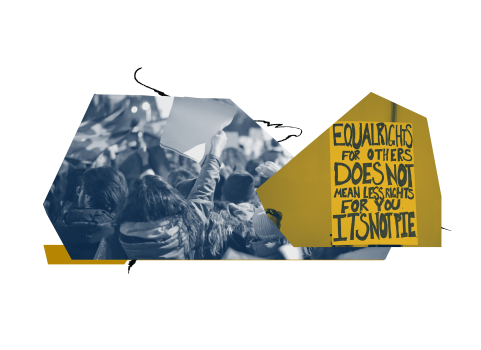
Collage graphic showing a crowd of people at a protest holding signs, paired with a yellow panel displaying a handwritten message that reads ‘Equal rights for others does not mean less rights for you. It’s not pie.’ The design uses navy and gold tones to highlight equality and solidarity.

Equal protection under the law is one of Nevada’s proudest constitutional guarantees. Yet the federal government continues to attack long-standing protections and promote discrimination disguised as “fairness.” We cannot allow those in power to turn Nevadans against one another and erode our state’s commitment to equality.

Nevada is home to the nation’s most expansive state Equal Rights Amendment and ACLU of Nevada works to make those protections a reality. Equality under the law protects us all, not just some.

The Latest

Know Your Rights
Collage graphic featuring a rainbow pride flag on the left and a black-and-white photo of two people smiling at each other on the right.

LGBTQ+ Nevadans

Every Nevadan deserves to live with dignity, safety, and respect, regardless of who they are or who they love.
Know Your Rights
Collage graphic featuring a rainbow pride flag on the left and a black-and-white photo of two people smiling at each other on the right.

Personas LGBTQ+ en Nevada

Cada persona en Nevada merece vivir con dignidad, seguridad y respeto, sin importar quién sea o a quién ame.
Know Your Rights
Collage graphic showing a person speaking into a megaphone at a protest on the left and a purple-tinted image of the Statue of Liberty on the right.

Equal Protection for K-12 Students

When young people feel they belong and have access to diverse spaces, they can fully engage academically, increase understanding and respect across differences, and succeed in society.  
Know Your Rights
Collage graphic showing a person speaking into a megaphone at a protest on the left and a purple-tinted image of the Statue of Liberty on the right.

Protección Igualitaria en las Escuelas K-12

Cuando los jóvenes sienten que pertenecen y tienen acceso a espacios diversos, pueden participar plenamente en el ámbito académico, aumentar la comprensión y el respeto entre las diferencias, y tener éxito en la sociedad.
Court Case
April 27, 2026

Filutowski v. Las Vegas Metropolitan Police Department (Amicus)

Sebastian Filutowski sold his Camaro in a legitimate transaction and received payment in cryptocurrency, which he converted to U.S. dollars. LVMPD later froze and seized more than $50,000 from his bank account through its Cyber Investigative Group policy. Under that policy, detectives can seek a warrant without notifying the property owner, classify the person as a “secondary victim,” and transfer the money to another person without filing a forfeiture case or providing an adversarial hearing. Filutowski filed a lawsuit seeking the return of his property and an order blocking law enforcement from using property seizure practices that deny people due process. The district court ordered LVMPD to return his money but denied his request for a permanent injunction. Filutowski appealed that decision to the Nevada Supreme Court. We filed an amicus brief, in partnership with Nevada Attorneys for Criminal Justice, because law enforcement should not be allowed to bypass due process through internal policies that function like civil forfeiture while avoiding forfeiture safeguards. In our brief, we argue that LVMPD’s Cyber Investigative Group policy has the same real-world impact as civil forfeiture: a person loses access to their property and must fight the government to recover it. We also argue that the harm occurs when the property is taken, not only after someone has exhausted every possible legal remedy. Returning money months later does not erase the violation or the cost of being forced to litigate for basic constitutional protections.
Court Case
September 23, 2025

City of Sparks v. Bluth (Amicus)

In 2023, a Reno police officer pulled over a driver and took her cell phone, claiming he needed to verify her insurance coverage. Instead, he unlawfully accessed and copied intimate photographs of the driver without her knowledge or consent. Nine months later, Sparks police detectives came to her home, showed her the photos, and confirmed they were taken from her phone. The driver, Bluth, sued to get access to public records about the investigation, but the lower court found that the investigative and privacy interests outweigh the public and personal interests, even without reviewing the records privately. The court only provided records related to her individual case. We filed an amicus brief, alongside the Boyd School of Law’s Survivor Representation & Advocacy Clinic, supporting Bluth’s appeal. We’re asking the Nevada Supreme Court to overturn the lower court’s decision and make clear that the government can’t use victims’ rights as an excuse to avoid accountability.
Court Case
May 20, 2025

Ybarra v. Warden (Amicus)

In 1979, appellant Robert Ybarra Jr. was convicted of capital murder and sentenced to death by a jury. Mr. Ybarra lives with serious mental illness, and the jury that sentenced him to death was not instructed that it needed to find beyond a reasonable doubt that aggravating circumstances outweigh mitigating ones, such as mental illness. Capital defendants who live with serious mental illness, like Mr. Ybarra, are more likely to be sentenced to death. This is because symptoms of their mental illness often impair trial and appellate proceedings, leading to unreliability in sentencing. The ACLU’s Capital Punishment Project and State Supreme Court Initiative, along with the ACLU of Nevada, filed an amicus curiae brief arguing that Article 1, section 6 of the Nevada Constitution—which prohibits cruel or unusual punishment—bars the execution of individuals with serious mental illness. As the brief argues, executing capital defendants with serious mental illness is cruel and lacks penological justification. It further argues that executing capital defendants is unusual given evolving standards of decency and increased protections for individuals with mental illness. Amici urge the Court to recognize that executing capital defendants with serious mental illness is unconstitutional and to categorically exempt this population from execution.
Court Case
September 15, 2025

Gerwaski v. State of Nevada

We are representing Students for Justice in Palestine at the University of Nevada-Las Vegas (SJP UNLV), a student group that protests Israel’s military actions in Palestine and exercises its First Amendment rights by organizing protests and advocating on social media, and has also urged UNLV administrators to stop supporting Palestinian people by not investing money in groups tied to Israel. We stepped in after another UNLV student who disagreed with SJP UNLV’s views sued the group, along with several other defendants, under the federal Anti-Terrorism Act (ATA) and for intentional infliction of emotional distress, even though the student did not show how UNLV SJP assisted in terrorism or explain how they were harmed. We filed a motion to dismiss, asking the court to dismiss the case because SJP UNLV’s advocacy is protected by the First Amendment, and the student failed to provide sufficient facts related to claims of infliction of emotional distress. We also filed a second motion under Nevada’s anti-SLAAP (Strategic Lawsuits Against Public Participation) laws, which protects people and groups from lawsuits meant to silence speech on public issues.