
By Michael Lyle, Nevada Current
This piece was originally published in the Nevada Current.
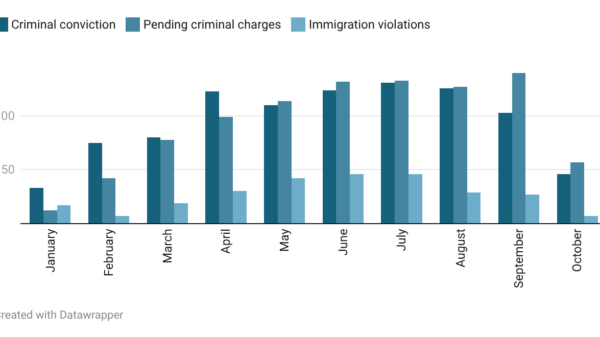
Nevada has not seen the barrage of armed federal officers carrying out immigration enforcement that other cities have seen, but immigration arrests in the state increased drastically last year, with at least 2,155 detained in the first 10 months of President Donald Trump’s second term.
The number of people arrested in immigration enforcement and removal operations under Trump is three times larger than former President Joe Biden’s final year in office in 2024, which saw 634 arrests throughout the state.
The Deportation Data Project, a group of academics and lawyers that collects and shares U.S. government immigration enforcement datasets, has compiled data or arrests nationwide through Oct. 15.
All arrest data was obtained through public information requests and litigation and most likely doesn’t represent the full scale of arrests or deportation efforts.
Roughly 70% of people who were arrested in Nevada had been detained through local jails and detention without any clear indication in the data of what their underlying offenses were, and more than 40% had no criminal convictions or records.
In an email to Nevada Current, Deportation Data Project explained that street-based arrests or “immigration raids,” which are a smaller portion of the numbers of those arrested, can show up in the data as “non-custodial arrest” and “located” categories.
The Current analyzed the data and found 273 “non-custodial” arrests and 326 identified under “located” categories, a 700% and 300% increase respectively from 2024.
In Biden’s final year of office, the project only found 34 “non-custodial” arrests and 83 under the “located” categories.
Of those arrested, a large majority — 1,276 people — were from Mexico while 175 people were from Guatemala and 154 were from El Salvador.
Nevada immigrant advocates and civil rights attorneys say there are many unanswered questions about who is being arrested by U.S. Immigration and Customs Enforcement.
But the one thing that is becoming clear is “the story of 2025 was a story of massive increase in ICE arrests,” said Michael Kagan, director of the UNLV Immigration Clinic.
“Just because we don’t have people in armed fatigues walking through East Las Vegas does not mean that ICE has not ramped up considerably,” Kagan said. “ICE is here and is making more arrests than ever.”
The U.S. Department of Homeland Security didn’t respond to numerous requests for comment.
The UNLV Immigration Clinic and the ACLU of Nevada have both struggled to track the full scope of people detained, arrested and deported.
Despite submitting records requested to DHS and local agencies to figure out who is being detained, the numbers “are not typically put out in a very transparent fashion,” said Athar Haseebullah, the executive director of the ACLU of Nevada.
He also doubts federal agencies’ willingness to provide accurate information, adding the administration “is insistent and open to lying.”
The data collected by the Deportation Data Project confirms what the UNLV clinic is seeing through client intakes and calls from the community, Kagan said. People accused — not always convicted — of low-level offenses are being swept up in immigration enforcement and the deportation process.
The data might be incomplete, but it does provide a snapshot of what is happening in Nevada.
“The hard part is because the enforcement actions are often taking place on residential streets and neighborhoods, there’s no way to accurately understand the full gamut of how they’re operating here,” Haseebullah said.
They haven’t had their day in court
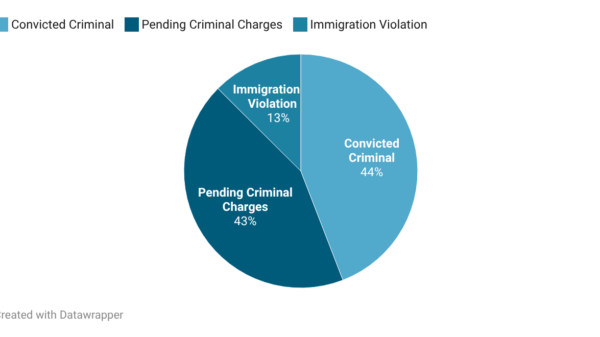
The data analyzed by the Current showed 43% of cases — 934 arrests — were listed as “pending criminal charges” without any indication of what those charges could entail.
“I think it’s really key and important to remind people that an arrest means nothing,” Haseebullah said. “It’s indicative of nothing. You haven’t had your day in court. If we started basing everything off arrests alone, then our system of justice would be useless.”
Trump and White House officials repeatedly claim immigration enforcement is going after the “worst of the worst.”
But from the cases Kagan has seen through the clinic, these arrests are commonly DUIs and other issues like “low level drug offenses” like simple possession.
“You’re not talking about the worst of the worst, as they usually describe it,” he said.
The aggressive immigration enforcement is circumventing the normal criminal justice system and people’s ability to challenge the offenses they are accused of.
“We have clients who have a pending DUI charge and have a very strong account for why they think they are innocent of the DUI,” Kagan said. “I think that the district attorney probably has never heard their version of events, and that’s unfair.”
Another 44% of the cases, 951 arrests, are listed as having a criminal conviction, but again the data doesn’t specify what the conviction was for or how long ago the arrest was.
The category of what could be considered a criminal conviction is too broad, Kagan noted, and doesn’t distinguish between crime like low-level drug possession or a Class-A felony such as murder.
The ambiguity plays on the “rhetoric casting all immigrants as if they are Class-A felons,” he said.
The administration’s implementation of its crackdown “makes no distinction between a homicide conviction and trespass,” Kagan said. “I think to meaningfully talk about this the way normal people would think of it, you’d need to know what kind of crime” the people being arrested have been accused of, “and they don’t provide that data.”
Another lingering question is how old some of these convictions are, Haseebullah said.
There have been cases where people are being swept up on decades-old convictions.
Haseebullah said he was informed of an arrest and a conviction for a DUI that occurred in 1990.
Another 270 cases in the data are categorized as immigration violations. The data doesn’t provide any further information on those violations.
Two systems of justice
The increased immigration enforcement is not only sweeping more people into deportation, but also created two systems of justice, Kagan said.
For a U.S. citizen, if they are arrested for an offense like DUI or low-level drug possession, they would have their day in court where they are innocent until proven guilty.
Immigrants will never face trial and instead will “just be handed over to ICE.”
The initial arrest “is just the front end of the deportation pipeline,” Kagan said. “We find, anecdotally, with our cases, some of them have no criminal record. Some of our clients and prospective clients were arrested on something like a DUI.”
For those who could be found guilty and convicted of a crime, “they may actually not face the punishment that a citizen would face,” Kagan said.
The system makes ICE a “getaway driver” for cases that could normally carry serious prison time.
Local police at the ‘front end’ of deportation system
The largest number of immigration arrests in Nevada last year — more than 1,500 — were people who were already incarcerated by state and local law enforcement, according to the Deportation Data Project.
Clark County Detention Center accounted for 633 of the arrests through Oct. 15. There were 140 immigration arrests at the jail in 2024.
“That means that basically Las Vegas (Metropolitan Police Department) and other police departments are the front end of the deportation system,” Kagan said.
The data only found one instance of law enforcement complying with 287(g) agreement, by which local authorities help ICE holding people in custody after their release.
LVMPD ended its 287(g) involvement in 2019 but authorized a new agreement in summer 2025. The new agreement is likely not yet reflected in the available data, Haseebullah noted.
Laken Riley Act one year later
Trump’s focus on carrying out more immigration enforcement by detaining and deporting was part of a campaign promise. The Laken Riley Act, which he signed into law during his first month of office and touted as part of his fulfillment of that promise, was a mechanism that critics warned would give the administration more leeway to detain more immigrants by depriving them of their due process rights.
The legislation allowed for undocumented immigrants arrested or charged with crimes like shoplifting, theft and larceny to be detained even if there isn’t a conviction.
Nevada’s entire Democratic delegation voted for the bill despite heavy pushback from immigration attorneys and groups.
Haseebullah said the bill was terrible “namely because it sort of crushed the notion of civil liberties in due process.”
It’s hard to get a full understanding how the act has affected people in Nevada, he said.
The UNLV Immigration Clinic has only successfully litigated one case “to prevent the application of the Laken Riley Act to someone who had been found innocent by a jury,” Kagan said.
The case has been sealed and he was unable to provide further details, except that “DHS pressed forward and wanted to detain them as if they were still guilty.”
If federal agents only relied on the Laken Riley Act to detain more immigrants, “that would have been bad enough,” Haseebullah said.
“It seems almost as if they saw a hurdle in the form of Laken Riley Act and jumped over it,” he said. “Now they just ignore the Fourth Amendment” which protects people from unreasonable searches and seizures “and every basic constitutional protection as a whole.”
Kagan agreed that current tactics by federal immigration officials essentially rendered the Laken Riley Act irrelevant.
Instead, the administration is focused on mandatory detention “of basically every undocumented immigrant,” he said.
Though it seems agents have bypassed the federal legislation, Kagan said Democrats should have never voted for the Laken Riley Act.
“I think it does not speak well of an elected official when they can only stand for immigrants, when Gallup polls tell them that the weather is good,” Kagan said. “I think that they would do better to indicate to the public that they stand firm in a position even when the polls run one way or the other.”